AI-Powered Digital Marketing: Strategies & Benefits

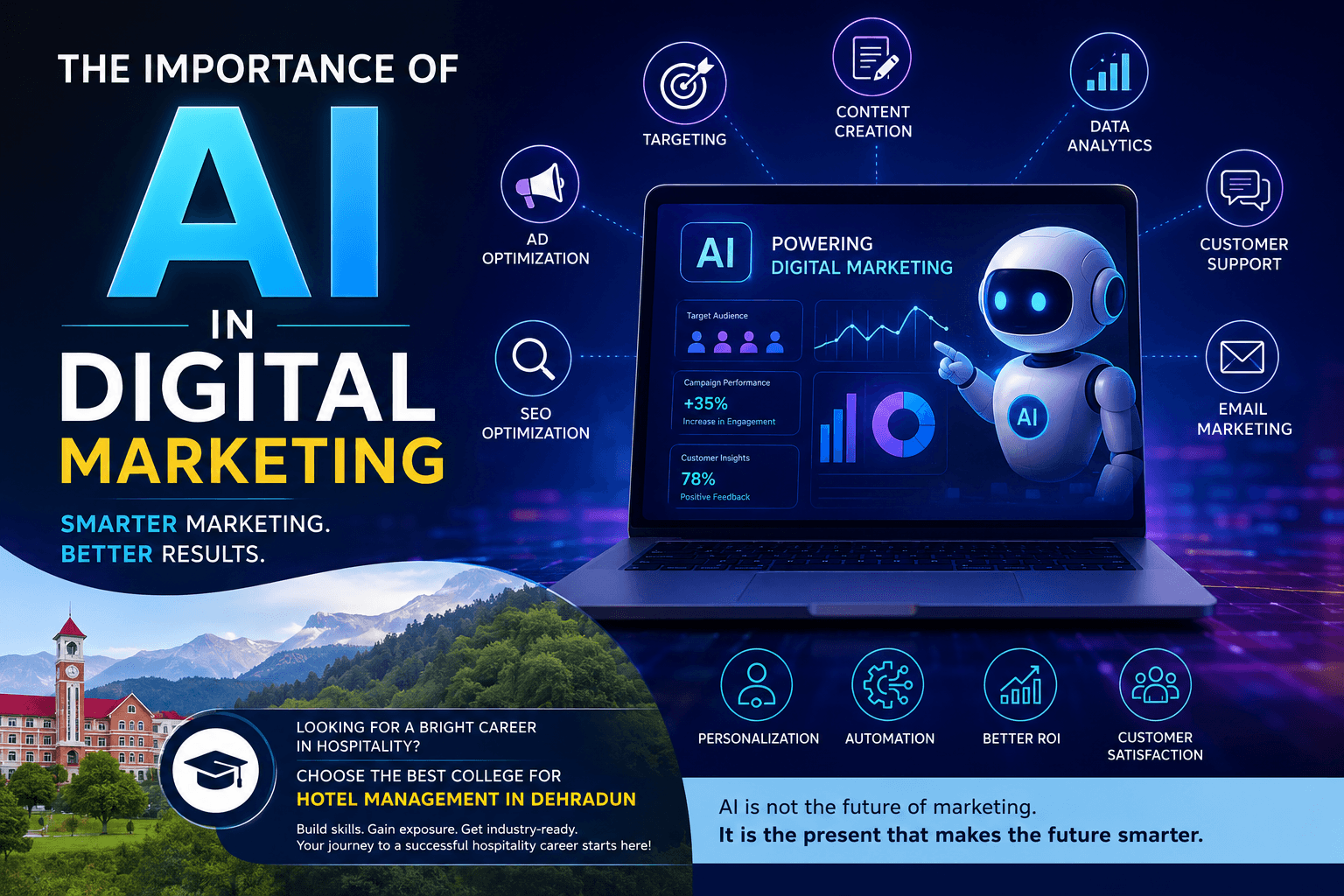
AI-Powered Digital Marketing: Strategies, Benefits and Real-World Uses
Digital marketing has changed dramatically over the past few years. Businesses no longer depend only on traditional advertising methods to reach customers. Today, brands use search engines, social media, email, websites, online advertising, and data analytics to connect with their audiences.
Artificial Intelligence (AI) is taking this transformation even further.
AI-powered digital marketing allows businesses to analyze customer behavior, automate repetitive processes, personalize communication, optimize campaigns, and discover valuable insights from large amounts of data.
For marketers, AI is becoming less of an experimental technology and more of an everyday productivity and decision-making tool.
What Is AI-Powered Digital Marketing?
AI-powered digital marketing refers to the use of artificial intelligence technologies to improve different marketing activities.
AI systems can analyze information, recognize patterns, generate content, predict possible outcomes, and automate certain tasks.
Some common applications include:
Search engine optimization
Content marketing
Social media marketing
Online advertising
Email campaigns
Customer support
Audience research
Marketing analytics
Lead management
Personalization
The main objective is to make marketing more efficient while delivering a better experience to customers.
How AI Is Changing the Marketing Process
Traditional marketing often involves collecting information, analyzing reports, creating campaigns, monitoring performance, and making adjustments manually.
AI can support many of these activities.
For example, marketers can use AI to identify customer trends, analyze campaign performance, generate content ideas, segment audiences, and automate repetitive communication.
This allows marketing teams to focus more on strategy and creativity instead of spending most of their time on routine tasks.
1. AI Helps Businesses Understand Customers
Successful marketing starts with understanding the audience.
AI can analyze different types of customer behavior, including website interactions, search activity, engagement, clicks, and purchasing patterns.
These insights can help marketers identify:
What customers are interested in
Which content receives the most engagement
What products or services attract attention
Where customers leave the buying journey
Which audiences are most likely to convert
Better customer understanding allows businesses to create more relevant marketing campaigns.
2. AI Improves Audience Segmentation
Not every customer has the same requirements.
AI can help businesses divide audiences into smaller groups based on their behavior and interests.
For example, an education website might have visitors looking for undergraduate programs, professional courses, career guidance, or admission information.
Instead of presenting identical content to everyone, marketers can create different campaigns for each audience group.
This makes digital marketing more targeted and relevant.
3. AI Makes Content Creation Faster
Content creation is one of the most time-consuming parts of digital marketing.
AI tools can help marketers brainstorm ideas and prepare initial content for different platforms.
They can assist with:
Blog topics
Headlines
Content outlines
Social media posts
Email campaigns
Product descriptions
Ad copy
FAQs
Meta descriptions
However, marketers should always review AI-generated content before publishing it.
Human editing helps ensure that content is accurate, original, useful, and aligned with the brand's voice.
4. AI Can Strengthen SEO Strategies
Search engine optimization requires marketers to understand what users are searching for and why they are searching for it.
AI can assist with keyword research, topic discovery, search-intent analysis, content planning, and identifying related questions.
For example, a website targeting students interested in hospitality education could create an informative guide around the keyword "best college for hotel management in dehradun."
Rather than repeatedly inserting the keyword, the article could discuss:
Course structure
Practical training
Faculty
Campus facilities
Industry exposure
Internship opportunities
Placement support
Career opportunities
This creates useful topical depth while naturally addressing the user's search intent.
5. Smarter Digital Advertising
Digital advertising produces a huge amount of performance data.
AI can analyze this data and help marketers understand which audiences, advertisements, and campaigns are performing better.
AI can support:
Audience targeting
Ad personalization
Campaign optimization
Performance analysis
Conversion prediction
Budget planning
Instead of waiting until the end of a campaign to analyze results, marketers can use ongoing data to make adjustments.
6. Personalized Customer Experiences
Modern consumers expect brands to understand their interests.
AI can help businesses personalize experiences by analyzing previous interactions and preferences.
For example, an online learning platform could recommend courses based on the subjects a visitor has previously explored.
An e-commerce website could recommend products based on browsing behavior.
Personalization can make the customer journey more relevant and convenient.
7. AI Chatbots Improve Customer Support
Customers often have simple questions that need immediate answers.
AI-powered chatbots can handle many frequently asked questions without requiring a human representative for every interaction.
Businesses can use chatbots to provide information about:
Products
Services
Pricing
Courses
Admissions
Application processes
Working hours
Frequently asked questions
For complex issues, the conversation can be transferred to a human support team.
This creates a combination of automated assistance and human support.
8. AI Can Transform Email Marketing
Email marketing becomes more effective when communication is relevant to the recipient.
AI can help marketers analyze customer behavior and create different audience segments.
For example, an education business could send different messages to visitors who have only viewed a course, downloaded information, requested a callback, or started an application.
This allows businesses to communicate according to the customer's stage in the journey.
9. Predictive Analytics for Better Marketing Decisions
AI can analyze historical information and identify patterns that may help marketers anticipate future behavior.
Predictive analytics can help businesses estimate:
Which customers may be more likely to convert
Which products could receive greater interest
Which content may perform well
Which marketing channels are producing better results
When customers are more likely to engage
These predictions are not guarantees, but they can provide useful information for planning campaigns.
10. AI Makes Social Media Marketing More Efficient
Social media platforms generate enormous amounts of engagement data.
AI can help marketers understand which content formats, topics, and messages are receiving better responses.
For example, a business may discover that educational videos receive more engagement than promotional posts.
The marketing team can then use this information to improve its content strategy.
AI can also help generate content ideas, analyze trends, and organize social media workflows.
Benefits of AI in Digital Marketing
The adoption of AI provides several important benefits for businesses.
Increased Productivity
Automation allows marketers to spend less time on repetitive tasks.
Faster Data Analysis
AI can analyze large amounts of information quickly and identify useful patterns.
Better Personalization
Businesses can deliver more relevant content and recommendations.
Improved Targeting
AI can help marketers identify and segment audiences based on behavior and interests.
More Efficient Campaigns
Continuous analysis can help businesses identify opportunities for campaign improvement.
Better Customer Experience
AI-powered recommendations and support can make online interactions faster and more convenient.
AI and Human Creativity Should Work Together
Although AI has powerful capabilities, successful marketing still requires human involvement.
AI can help with research, analysis, automation, and content assistance. Humans are still needed for:
Creative ideas
Brand storytelling
Strategic decisions
Emotional understanding
Communication
Fact-checking
Building relationships
The strongest marketing strategies combine technological efficiency with human creativity.
Challenges of Using AI in Digital Marketing
AI also comes with certain challenges.
AI-generated information may sometimes be inaccurate or lack context. Businesses also need to consider privacy and responsible handling of customer data.
Another challenge is maintaining authenticity. If every piece of communication becomes heavily automated, customers may feel that a brand lacks a personal touch.
Businesses should therefore use AI carefully and maintain human oversight.
How Businesses Can Start Using AI
Companies do not need to implement every AI tool at once.
A practical approach is to start with specific areas where AI can provide immediate value.
Businesses can begin by using AI for:
Content brainstorming
Keyword research
Customer FAQs
Data analysis
Email segmentation
Social media research
Advertising analysis
Marketing automation
After understanding these applications, businesses can gradually introduce more advanced AI solutions.
Why Students Should Learn AI and Digital Marketing
The growing use of AI is also creating new opportunities for students interested in marketing.
Digital marketing professionals are increasingly expected to understand both marketing principles and modern technologies.
Students can develop skills in:
SEO
Content marketing
Social media
Google Ads
Analytics
Copywriting
AI tools
Marketing automation
Customer research
Data interpretation
Learning these skills can help students adapt to an industry that is becoming increasingly technology-driven.
What Does the Future Hold for AI Marketing?
AI is likely to become an even larger part of digital marketing.
Future marketing platforms may offer more advanced personalization, real-time customer insights, automated campaign management, predictive recommendations, and AI-assisted creative tools.
However, technology will not eliminate the importance of trust and human connection.
Businesses that successfully combine AI with authentic communication and strong marketing strategies will be better prepared for the changing digital landscape.
Conclusion
AI-powered digital marketing is changing the way businesses understand customers, create content, optimize campaigns, and communicate online.
From SEO and advertising to social media, email marketing, analytics, and customer support, AI can improve many aspects of the marketing process.
The goal should not be to replace human marketers with technology. Instead, businesses should use AI to reduce repetitive work, discover useful insights, and give marketers more time to focus on creativity and strategy.
As AI continues to evolve, learning how to use it effectively will become an increasingly valuable skill for businesses, marketers, and students.
You may also like
gowshikak - Friday, 2 May 2025
Digital tools to enhance online teaching in 2025
muthamil-selvan - Saturday, 6 Jun 2026
The Property Search - Your Search Ends Here
Comments(0)
Be the first to comment.